Monday, October 1, 2018

Post Einsteinian History


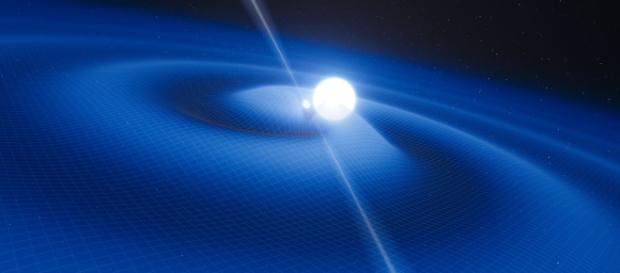
Einstein's gravity theory passes toughest test yet: Bizarre binary ... - phys.org


Are there methodologies that view history from an Einsteinian perspective of time and space?  If time and space are curved rather than linear, and we flatten them out.  Doesn't that mean the way we record historical events is skewed?  

Theologians and philosophers around the globe are adapting the world view developed before the Theory of Relativity was made known.  Theologians like  Ilia Delio, OSF is on the leading edge of this movement within the Catholic faith, but she comes at it from an interfaith perspective.   

The Copernican world view inexorably changed the Church and its theology despite vigorous resistance against it by men and women bound by the disproved Ptolemaic construct of the cosmos. 

The current shift to an Einsteinian view of time and space is having profound ramifications for our understanding of God and theology.  The movement is under siege by those who stand on an authority set in the clay foundation of an old-world construct that crumbling beneath them.  The movement forward is unimpeded by that resistance.  

The earth is not at the center of the universe and man in not the apex of creation. Humanity, as we know it, is not the final word of the creation story.  This does not mean that God or Christ are irrelevant, but the traditional depiction of God and Christ distorted by an anthropocentric bias must be set aside in order for the fuller perspective to be seen.
 
Reflections from Ilia Delio retreat based on her new book  A Hunger for Wholeness: Soul, Space, and Transcendence. 

Thursday, February 1, 2018

Arrivederci, Roma!


Today I am finishing up several weeks of study of documents related to women’s ordination and the female saints who lived between 375 CE when the Apostolic Constitutions laid out guidelines for women deacons and 425 CE when the Council of Orange forbade ordaining women to the diaconate.  These past two weeks in the Vatican Library and Secret Archives have been an honor and privilege beyond my wildest imagining.   

I am grateful to my friends working with St. Mary’s College “Walking in the Footsteps of the Early Christians,” Fr. David Gentry-Akin, Dr. Robert White and Heather Walker, Fr. Thomas Thompson and Fr. Johann Roten at the Mariological Society of America and Dr. Margaret McGuiness at the American Catholic Historical Association for making this research trip possible.  I also want to thank my supervisor Benita McLarin and my counterpart Rev. John Onuoha at Santa Clara Valley Medical Center who support my studies for the renewal of chaplain certification with the National Association of Catholic Chaplains. 


In my last few days in Italy I will visit the basilicas and catacombs of San Gennaro, San Severo, San Gaudioso and Santa Maria della Sanità in Naples; and several basilicas in Rome as well as Chiesa del Gesù, the mother church of the Society of Jesus, where Fr. Kevin Ballard, SJ suggested I see Giuseppe Valerinao’s painting of the Visitation by the Virgin Mary.  There I will say prayers for all my Jesuit friends and colleagues.   

I have already visited the basilicas of Santa Maria Maggiore, San Giovanni in Laterano, San Lorenzo and San Paolo Fuori le Mura, San Clemente, Santa Prassede, Santa Maria and Santa Cecilia in Trastevere and Santa Maria del Popolo.  I will end my trip with a visit to Saint Catherine’s tomb at Santa Maria Sopra Minerva and Transito di Santa Caterina da Siena in Piazza Santa Chiara, the room where St Catherine of Siena died of massive stroke in 1380 that is now a devotional chapel.   

I have posted photos and brief descriptions of these visits on Facebook.  You can find me there under the username donnamariamoses. Arrivederci, Roma!