Thursday, January 19, 2012

Eighth Candle

We took the rail all the way down the length of the country from Carlisle to Canterbury.  The rain is hot on our heels. So far we have been very fortunate with mild temps and no rain.  We are heading to Canterbury to get out of the way of a storm coming across from Ireland.

We saw beautiful green hills and more sheep than I've ever seen in my life.  We arrived just in time for Evensong at Canterbury Cathedral. It is Christian Unity week and there are prayers for the Pope and people of all denominations.  We visited the crypt of Saint Thomas a Becket and the site of his martyrdom  where I lit the eighth
candle for you. Here we prayed for our family members, sisters and friends who have died recently, and those who mourn them.

Wednesday, January 18, 2012

Seventh Candle

Today after visiting the bones of my ancestors at St. Cuthbert's in Carlisle we toured along Hadrian's wall to Newcastle and down to Durham where we visited the Cathedral and Castle there. Durham Cathedral was built in 1083 and is the first to employ the ribbed archways that became so characteristic in the Gothic era.  It is the final resting place of St. Cuthbert and the Venerable Bede.

For the seventh candle we prayed in the Lady Chapel where a modern statue depicting a rough hewn Mary transfixed at the annunciation stands in front of the tomb of the Venerable Bede.  Here I prayed for all historians and scholars of the Word that Our Lady of the Annunciation will send many graces and the Spirit will sustain the energies needed to persevere in study.

Tuesday, January 17, 2012

Sixth Candle

We took the rail up through the lakes district to Carlisle on the border with Scotland. This is the home of the Royal Border Regiment but much is closed down in the winter. Carlisle Castle is an impressive fort on the west end of Hadrian's Wall.  The Cathedral was built in 1122 and has many memorials to fallen soldiers through the years of dispute at this boundary established by the Romans.  

The museum features archeological finds from Roman encampments and later times.  This city seems to have always had a military character.

My explorations on
ancestry.com found that my ancestors on both mother and father's side are from this part of the world. In the 17th century there are records of my forefathers who were buried in St. Cuthbert's here in Carlisle.   We are visiting the cemetery there today to see if we can find the old bones.

It began to rain for the first time today and we ducked into a theater.  

Lo and behold "The Iron Lady" was just starting, so we took in the film.  If you haven't seen it, you will be surprised by the format which travels back and forth in time from when Margaret Thatcher was in her later years suffering from dementia and her life as Prime Minister.  The acting is super, and the film raises some interesting questions about the strains of a political life and its effects on the psyche.

I lit a candle for you in Carlisle Cathedral where I found this beautiful unnamed image of Mother and Son.  I love the way she is lifting him up to the light.  There was no place to light a candle, but I said a prayer for all of you who lift up others through your teaching, your ministry, your inspiration and your support in so many ways.  May God bless you with strength and reward you with love. 

Monday, January 16, 2012

Fifth Candle

Today we arrived at last at Stone where we were met at the rail station by Sister Pauline, the major superior of the Dominican Sisters of Stone. Over a cup of tea and some Belgian biscuits we had a nice little chat about our congregations and our own spiritual journeys. Sister Pauline gave me a copy of their recently (2011) published congregational history titled "A Peculiar Kind of Mission." I promised to send her our own when it comes out in print.

Sister Cecily gave us a tour of the archives and copies of photos and documents related to my study.  We discussed the connection between our congregation and theirs and searched for record of visits mentioned in Mother Pia's diary in their annals.  Unfortunately nothing is recorded about those visits.  Sister Cecily showed us a treasure chest of first editions and scrap books belonging to Francis Raphael Drane.  I took photos to share when I get home.


Sister Mary Henry took us an extensive tour of inside and out upstairs and down and told us the stories of the people and places who are precious to them.  I was able to videotape some of this and took photos of the shrine of Our Lady of Stone and the resting places of Mother Margaret, Francis Raphael Drane, and Bishop Ullathorne.


I lit your fifth candle and we prayed with the image of Our Lady Refuge of Sinners that is believed to be the first one used in public processions of Our Lady in England after the Act of Emancipation of Catholics in 1829.   We prayed for all members of the Dominican Order, particularly those on mission in areas where life is hard and religious are persecuted because of their faith. We prayed for perseverance in the face of difficult decisions and economic hardship and for Our Lady to protect all who preach the Gospel with Love and Truth. 

Saturday, January 14, 2012

Fourth Candle

Yesterday in Stratford upon Avon we stayed in a hotel built in the 16th century and visited Shakespeare's birthplace, his daughter Susanna's home and the home he lived in after he was married. Today we visited Anne Hathaway's cottage and the farm where his mother's family lived.  Here we get a real sense of Shakespeare as a family man despite his being, as the locals say with a twinkle, "rather naughty.".

We had afternoon tea with delicious salmon and cucumber sandwiches, profiteroles and frangipane.  These scones (see attached) will have to suffice as our
fourth candle as no Blessed Mother shrines were to be found.

We saw the play "Written on the Heart" about the translation of the Holy Bible into English and the controversies that raised. It reminded us of the challenges we have with the new Roman Missal.


Peace to you and all your families this fine Sunday afternoon.

Friday, January 13, 2012

Third Candle


Today we toured Stonehenge, Old Sarum and St. Thomas's Church, dedicated to the memory of Thomas a Becket.  The bus took us through the broad plains of Wiltshire where we saw pheasant, geese, sheep, pigs, bulls, deer, ravens, falcons and partridge all feeding quietly on the vast green landscape.  Here and there were burial mounds and long barrows and other ancient sites still a mystery to archeologists.

No matter how many times you've seen it in pictures when you see Stonehenge in reality the effect is humbling.  To me this ancient structure and Windsor castle seemed to be variations on the same theme. Both are massive round structures overlooking the countryside below surrounded by a protective moat and shrouded in mystery.  In the photos this similarity may not be so striking as it is when you see them back to back as we did.


In the photos I hope you can make out the interesting solar phenomenon I caught with the camera making it appear like candle in the great outdoors.  I took time to pray here for our striving to live in more harmonious atunement with the rest of the cosmos. Stonehenge was built at a time when science and religion were not divided. Rather both were expressions of the human search for understanding.  I hope we can continue to regain a better sense of that unified wisdom through our common study of the new cosmology.

Tuesday, January 10, 2012

Second Candle

The highlight of today's spiritual journey was the visit to Salisbury Cathedral.  We traveled by BritRail across the countryside and checked into our rooms at Sarum College, an ecumenical theological college housed inside "The Close" ...the area around the Cathedral enclosed by a great stone wall.  The more prominent part of the college was built in 1677 by Sir Christopher Wren. However, the site at 19 The Close as place of theological education dates back to the 1220's when the Cathedral itself was built.  And we think we have historic building renovation challenges! 

The theme of renovation challenges reemerged throughout the day.  We toured the tower, at 404 feet, the largest spire in England, a miraculous construction added a century later that bowed out the large four pillars in the central cross section above the quire.  From the Inside the tower, we were led up 332 very narrow steep stairs to inspect the way the builders used the native english oak, chilmark stone and purbeck marble, to accomplish the architectural feat of successfully mounting a tower weighing 6,500 tons on the immense columns below.  Our guide pointed out centuries of renovation that have helped to maintain this tower that continues to sway up to 8 inches back and forth in the wind and despite settling into a 27 inch westerly lean has survived fire and storm for 8 centuries. 

At the top of the spire there is an ancient clock mechanism that controls the bells that toll out the quarter hours and hour.  Above the clock, we were led outside the spire to a balcony that is home to some nesting falcons and enjoyed a stunning view of the city of Salisbury and the countryside around.  I will be sending video of this part of the tour later. 

Later inside the Cathedral we visited the tombs where Edward Seymour and Lady Catherine Grey, sister to Lady Jane Grey, are buried as well as numerous Bishops and local notables.  To the left of the main altar is a medieval Madonna made of the same oak as the Cathedral that dates back to the time of the original construction.  Here I lit the second candle for you.  My prayer here was for the Bold Awakening construction and the challenges we face in renovating our own historic buildings ...  which now seem far less daunting in comparison.  I asked the Blessed Mother's protection of all architects, engineers, builders and craftsmen as well as those who help maintain historic structures built in honor of and service of her Son, Our Lord Jesus Christ. 

Concluding our tour we visited the Chapter House, so called because here each day a Chapter of the Bible was read aloud in prayer prior to the meeting of the governors who convened as equals in the site of God to decide on matters for the common good.  The governing body of the Cathedral came to be called the Chapter as a result.  Our own Dominican governance descends from this concept.   The Chapter House at the Salisbury Cathedral holds the finest of four surviving leafs of the Magna Carta, the great English document that lay out the rights and freedoms of ordinary people, upon which our own democratic principles were founded.   Photographs of this fragile ancient document were not allowed. 

We are a little off our itinerary due to rail delays and subsequent rerouting of our train...an adventure itself!  Tomorrow we will visit Windsor Castle.  We've been advised by the locals to take in Bath which they claim is not to be missed if we've come so close.    For now, after carrying our luggage across the countryside and climbing the 332 steps, a bath is indeed what we most desire!

Monday, January 9, 2012

First Candle

This is a series of postings from our pilgrimage to England and Belgium where I am researching Dominican devotion to Mary in the late 19th century and its influence on Marian devotion in the United States and Canada.  I will present my findings at the annual meeting of the Mariological Society of America at Mount Angel in May.  Along the way I am stopping to pray at historic sites where I find shrines dedicated to the Blessed Mother.

We are being flexible with our plans given the fullness of our agenda and the idiosyncracies of winter transportation. Today we completed our touring and visiting in London. After a tour of the city from the upper deck of a double-decker bus, we paid a visit to St. Margaret's Church and toured Westminster Abbey, the Tower of London and the Sherlock Holmes Museum.

Seeing shrines to Our Lady in London is made especially difficult by the rampant secularization of British culture and the  ever hovering black shadow of the Reformation.  Even chapels dedicated to Our Lady lack a  quiet place to light a candle and pray.  Sadly signs point to where and how prayers once were said more often than where one might pray.


The highlight of the visit to London for me was arriving at the tomb of St. Edward the Confessor, who commissioned the building of the Abbey and seems to have been a good and holy man, just in time to join a small group of pilgrims invited to pray in the shrine where his tomb and that of his wife lie.  This shrine is the oldest and most fragile part of the Abbey and is off limits to tourists.  An Anglican priest led us in a centuries old litany of prayer for Christian unity and the protection of the Christian leaders of all nations, most especially her majesty the Queen.

This pause for prayer seemed especially meaningful as the tomb where Queen Elizabeth I and her sister Queen Mary are buried side by side was just across the aisle. In front of their elaborate sarcophagi was a vault marker enjoining travelers to remember those who suffered and died for the sake of their conscience and love of Christ under the division caused by the Reformation of the Church in England.


I took time to remember too our political rivalries at home in the US and how that division damages our vitality as a nation.  I prayed for the primary in my home state of New Hampshire and for a worthy opponent to emerge so that fruitful debate of the issues needing discussion can take place and move us closer to real freedom and democracy.


Later I prayed at the tombs of Anne Boleyn and Lady Jane Grey in the royal chapel of St. Paul ad Vincula in the Tower of London.


I lit a candle for you at the chapel of St. John the Baptist in the Abbey where I found a beautiful alabaster image of Our Lady.   This translucent Madonna was carved by an unnamed English nun in 1973 and placed in a niche where the outline of an ancient image can still be seen behind her.  


Before this image of the New Mary in the Old Mary's arms I prayed for the Blessed Mother's special protection over the Order and our Congregation to be vouchsafed and passed on to the next generation. I prayed for God to bless my research in his Mother's honor and to bless each of you as you stand behind one another and inspire each other to good works of praise.

Saturday, December 31, 2011

Resilience for the New Year

May the ending of 2011 be filled with glad moments of thanksgiving and the beginning of 2012 glimmer with signs of hope.  With prayers for a happier healthier year for all my blog readers, I am sharing this link to ten ways to build resilience.

Wednesday, December 7, 2011

Jesus in the Womb

“Do not be afraid, Mary, for you have found favor with God. Behold, you will conceive in your womb and bear a son, and you shall name him Jesus.” Luke 1:30


We know his life on this earth began in the womb, at the moment of his conception. And, so we know that the first part of his journey among us - the first part of the Word of God taking flesh and dwelling among us - was nine months in his mother's womb. But, we rarely reflect on this part of the presence of “God with us.” This exercise of our imagination for an Ignatian Contemplation with Jesus during that immersion into our life's journey is aided (except for a professional image of a developing embryo) by ultrasound images of a 5 month old child in the womb, just 10 inches long. This child will help us spend some time letting this profound reality touch our hearts and celebrate Jesus' entry into our world and to welcome Jesus into our hearts now.


From the moment that - “by the power of the Holy Spirit” - the life of Jesus began in Mary's womb, Jesus became one with us. He didn't magically appear as an adult. He began his life journey as a tiny, bundle of cells. We can imagine those cells multiplying so quickly, day by day and week by week - silently, imperceptibly. But, this human life was already “God, made one of us.” No one could imagine God could be human. And, now we can imagine our God coming among us in this developing, new life - so small, so dependent, so powerless. We can feel the gratitude welling up within us as we contemplate the unseen journey of Jesus being “knit” in his mother's womb (Psalm 139).


For more Advent Reflections visit Online Ministries at Creighton University

Tuesday, December 6, 2011

Son of God and Son of Mary

We can imagine that already, in this very fine development, he is taking on her flesh, her cells, her shape, her looks, her heart. It is so slow, and yet, so planned. It is a journey which none of us can remember, but which every one of us took, to become who we are. And, now we contemplate that profound solidarity with us which our Savior began - even in the womb, for us. Already, this sense we have of his entry into our experience helps us remember that he shared our human journey and we never need to feel alone, on any part of our journey. He became one of us by taking on the very way we enter this world. This transition to a life born into this world, and the continuing journey of a child, a young person, and finally as an adult, is one Jesus made, for us. And, in these moments, as we contemplate this mystery and its meaning for us, we grow in gratitude for that first coming and we grow in our longing for our relationship with Jesus to develop in intimacy and love.


Our praying is helped by our imagination. In this case, we are imagining something we know happened, but for which we have not usually had a visual image. We begin by naming our desire here. We ask to be blessed with the gift of hope. We long to be renewed in a sense of God's love for us in Jesus - by this coming here and now, where we need him the most. The promises which were fulfilled in this new life stir our hearts to have faith in those promises in the most challenging times of our journey today. This imaginative prayer allows us to pray more deeply, “Come, Lord Jesus. We await your coming. Come, O Lord.”


For more Advent Reflections visit Online Ministries at Creighton University

Monday, December 5, 2011

His Humble Foot

In this contemplation, we want to slow down our reflection and enter into the details and to acknowledge the silence, the slow growth, the precious reality of our Lord and Savior's taking on life as a human being. If we begin by imagining Jesus' foot in the womb, we can begin to savor, with wonder and awe the reality of this gift. We can picture Mary washing this little foot, right after giving birth to Jesus and laying him in the manger, unconcerned about the lowliness of that place. We can imagine that this tiny foot became the foot which walked our earth. With this foot, he learned to walk. Perhaps this foot was sandaled most of his life. Perhaps this foot was stubbed on the carpenter's bench in Joseph's workshop. This is the foot which left home and headed to the Jordan to be baptized by John. Of course, the sinful woman taught us about gratitude for his mercy by kissing and crying on this foot, and drying it with her hair. This foot stumbled along the way to his Crucifixion, where this foot was nailed to a cross - all for us.


For more Advent Reflections visit Online Ministries at Creighton University

Sunday, December 4, 2011

His Healing Hand

We can imagine his hands growing in the womb, slowly becoming the hands which first touched Mary's face and Joseph's beard. This little hand developed into the hand that learned to be a carpenter, a person with a trade, for others. With this hand, he embraced children and offered his tender touch to the sick and sinners. We remember this would become the hands with which he washed his disciples' feet as an example for our life of union with him. We know one day that he took the bread and the wine in this same hand and, giving thanks to God, gave it to his disciples, saying “This is my body. This is my blood.” And, the next day, the now adult, outstretched hand was nailed to a cross - all for us.


For more Advent Reflections visit Online Ministries at Creighton University

Saturday, December 3, 2011

His Mother's Features

As we contemplate Jesus, growing in the womb, becoming our servant Savior, it is touching to imagine his developing face. This profile of a face in the womb is the merest suggestion of the growth of the human face of our God with us. At this point, he would already be taking on his mother's features and developing her eyes. He'd have her nose, her chin, her ears and eventually, her hair. On this face in the womb are the smallest signs of reacting to stimuli, even pain. This face would one day give joy to the shepherds, the first of his people to see it, and the Magi, the first of the gentiles to look upon him. When he was a baby, he must have cried and felt hunger and he must laughed and smiled a lot. We can imagine the developing face of the child of Nazareth, the Jesus who smiled at his friends, even though the rumors swirled that he was illegitimate. We can give thanks for the face which looked up to heaven at his Baptism and saw the sky opened, with that powerful affirmation from God, his Father, “This is my beloved Son, in whom I am well pleased. Listen to him.” And the loving face of Jesus, which developed slowly and inevitably, was the face which tenderly interacted with many who had the privilege of seeing it in his lifetime. This is the same face which was spat upon and was covered with blood from the mocking crown of thorns, all for us.


For more Advent Reflections visit Online Ministries at Creighton University

Friday, December 2, 2011

His Loving Heart

As we conclude this contemplation of Jesus in the womb, we pause for a moment to reflect upon his heart, which developed, just like our hearts did, but which became not only the organ which pumped blood to invigorate the rest of his body, but which became the very image of his self-sacrificing love. In the West, we speak of the heart as the center of our emotions and feelings and the source of our loving. This little heart became a heart big enough to love sinners, the sick, the marginal. This heart was “on fire” with compassion and mercy. The heart of Jesus, which began beating in the womb of Mary, was eventually the sacred heart which was pierced with a lance on the cross and which, in the eyes of faith of John the Apostle and Evangelist, poured out the blood and water of the sacramental life of the Church which sustains us now. Into that wound in his side, the Risen Lord invited Thomas to put his hand and to believe. He told us that we are blessed who have not seen with our eyes, yet believe.


For more Advent Reflections visit Online Ministries at Creighton University

Thursday, December 1, 2011

Our Merciful Savior

Lord, Jesus, we thank you for these moments of grace in which you have opened our eyes to await your coming to us with expectant hope. Just as Mary was expecting to deliver you into this world, we hope to receive you into our hearts. Through this reflection, we are deeply grateful for the human way you came to us, the deep solidarity with all of humanity you have revealed to us. We give you thanks for these images which help us put together the hidden development of your body, which you so fully gave to us in the love you showed us on earth and in the Eucharist and the Sacraments which continue to nourish us and sustain us. We feel closer to you and we ask for the further graces we need to open our hearts to your healing mercy and love. Come, O Lord.


For more Advent Reflections visit Online Ministries at Creighton University

Tuesday, August 23, 2011

From Pope at World Youth Day

In his homily, the pope said the vision of that sea of happy souls "fills my heart with joy."


"I think of the special love with which Jesus is looking upon you. Yes, the Lord loves you and calls you his friends," the pope told the young.


In his homily at the Mass, Pope Benedict said faith is not about understanding a bunch of facts, "it is an ability to grasp the mystery of Christ's person in all its depth."


Even if it feels like a struggle at times, faith is not primarily about people working out their thoughts about God; it starts with the gift of God's love and God's reaching out to each person, he said.


Faith entails "a personal relationship with Christ, a surrender of our whole person, with all our understanding, will and feelings," he said.


But the pope went even further, telling the young that a personal relationship with Jesus always must be transformed into action, service and love for others. In addition, it must be lived within the church, the community of believers to whom Jesus entrusted his message and his mission of salvation.


"We cannot follow Jesus on our own," he said. Those who try "approach the life of faith with the kind of individualism so prevalent today" and risk not encountering the real Jesus or "following a counterfeit Jesus," he said.


Christ asks each person, "Who do you say that I am?" the pope said.


"Respond to him with generosity and courage, as befits young hearts like your own," he told the young.


"Let me urge you to strengthen this life of faith which has been handed down from the time of the apostles," he said. "Make Christ, the Son of God, the center of your life."


In his parting words of encouragement to the young pilgrims the pope said: “There is no reason to lose heart in the face of the various obstacles we encounter in some countries. The yearning for God which the creator has placed in the hearts of young people is more powerful than all of these."


The pope urged youth to follow Christ’s passion and “take upon our own shoulders the sufferings of the world, in the certainty that God is not distant or far removed from man and his troubles.”


He also named a new doctor of the church. St. John of Avila will become the Catholic Church's 34th doctor of the church and announced that the next World Youth Day would be held in Rio de Janeiro in 2013.

For the City and the World

Sister Marcia and I are back home with lots of stories about our experiences in Madrid. The witness of so many young people full of hope and joyful in their faith have made me feel more resolved in my commitment as a religious and firmer in faith. I loved the infectious joy of these young people from around the world in the streets and on the Metro. Madrid will never be the same! What a preaching the presence of those 500,000 has been for the city and the world! More videos are available on familyrosary.org/wyd.

Saturday, August 20, 2011

After the Rain the Vigil

The Pope returned when the stormed calmed with gold vestments and a magnificent monstrance was lifted up for Adoration of the Blessed Sacrament. The vigil began.

Rain Down Your Love on Your People

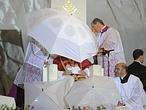
A glorious rain fell in the midst of the Pope's opening of the vigil at Cuatros Vientos cooling the pilgrims with the welcome blessing of rain. Umbrellas and hats popped up all around. Bishops dawned their white World Youth Day safari hats and joined in the amusement giving themselves up to the miracle of a refreshing if boisterous rain. The Pope smiled contentedly under his umbrella...his white hair blowing around in decorous tufts. It was a moment of simple joy and welcome relief from the August heat for a crowd of two million..double the expected attendance. The technology crew worked overtime protecting equipment and lines from water damage. The Pope's talk, interrupted by the storm, will be published on line later. He went backstage looking amused and grateful. The young people smiling and jumping in front of the camera agreed the storm was an unexpected blessing no one could have asked for but all seemed to enjoy. Tomorrow morning we will try to gain access to the area reserved for us by our tickets. How they will empty the area tonight and refill it tomorrow remains a question...but we will try!

Cuatros Vientos

Today we attended Mass in the Palacio de Deportes with over 50 Bishops from the USCCB and 300 priests at World Youth Day. We closed up our stations in the Internet Cafe and Vocations Cafe and went out to the old town to visit the Cathedral and Palace. We had lunch at El Botin...the oldest restaurant in the world according to Guinness Book of World Records. While we were in the restaurant the Pope passed by on his way to meet with the Seminarians. That makes twice we ran into him when we weren't looking for him. God's grace! When you are trying to run into him you have a long wait and a huge crowd. Now the pilgrims are on their way to Cuatros Vientos for the all night vigil. The Metro is amazingly efficient but very crowded right now. I'm catching up with uploading videoclips to The Teknosista Channel . This one is about the Internet Cafe.

Friday, August 19, 2011

Thursday, August 18, 2011

WYD Photo Album

This is a Link to my Facebook photos of Sister Marcia doing vocation work at the Palacio de Deportes, the Rosary Chapel and Eucharistic Adoration space, Mass with the Diocese of San Jose in the Jesuit Church of Franciso de Borja and waiting along the route of the Pope's arrival. I captured video of the Pope mobile moving along the route to Plaza de Cibeles for the welcoming.

Day of the Pope's arrival in Madrid

More photos from the day of the Pope's arrival are in the album on my facebook page. 

Viva il Papa!

The Pope arrives in Madrid today and people are lining the streets and singing songs. All along the route you can see bright colored flags of all the nations and young people in groups of 30-40 chanting Viva il Papa and waving. It is so heartening to see how the young are faithful to the Church and witnessing the faith with joy and hope. The message the presence of these 500,000+ speaks a profound truth that God is loved in the presence of the Holy Sacraments of the Church and in the Spirit of Communion alive in the Body. While the mainstream media promotes a false message that young people have no interest in their religion and that religious vocation is dying out, what we see with our eyes and hear with our ears at World Youth Day preaches the Truth that God is alive in our Church in our time.

Wednesday, August 17, 2011

The Teknosista's Shared Playlists

You can access my video playlists on YouTube

Tuesday, August 16, 2011

Live Streaming Video from World Youth Day

At the Media Center at the LOVE AND LIFE CENTER in Palacio de Deportes, we are uploading videos daily to the library and sharing live streaming video of events as they unfold. You can join us from home by going to this link.... http://www.livestream.com/wydcentral

Images of Christ at Museo del Prado

Sister Marcia and I saw some of the most amazing images of Jesus Christ ever painted at the Prado today. 

This link will let you see them from home...
http://www.youtube.com/watch?v=16yLX8pjKwo

Saturday, August 13, 2011

Volare


I am so excited to be packed and ready to go to Madrid finally! I'm watching a movie called Real: The Movie about the soccer team and those who follow them. I've been watching movies made in Madrid for weeks trying to catch flavor and the accent of Madrid and increase my comprehension of spoken Spanish. Marcia and I will be at Palacio de Deportes during the day and at all the major events. My only regret is not getting tickets for the grand finale soccer game. Soccer is my favorite sport. I played fullback in games at college in the U.S. and Austria. Right full back. No one came down my side of the field and made a goal ... ever! They came down my side, but if they did, they quickly decided to try the other side and not come back. I am easygoing in personality, but relentless by nature. I would not leave my mark alone until I had the ball out of there with many injuries to show for it. After two serious injuries, I gave it up in senior year. I have the bad left knee to show for it. No regrets though. I still love to watch it. I hope to take some great photos and video clips of all the events at which I'm present to share with young people. I am already hyped for World Youth Day 2014. Where will it be??? It is a tradition for a World Youth Day location to be announced at the World Youth Day preceding it... Does anyone have a guess? Tomorrow morning at 5:00 I am off to Madrid. I love to fly! Volare!!!

Thursday, August 11, 2011

Even the Rain

If you have not seen the movie Even the Rain, it is worth watching. There is an insightful interplay between the filming of a movie about the quest for gold at the time of the landing of Columbus in the new world and the quest for water in the present day. It is available on streaming video on Netflix. Spanish and Quechan with English subtitles.

Tuesday, August 9, 2011

Blessed Volunteers of Moreau

Yesterday, we had the blessings of a "cast of thousands" crew of volunteers from Moreau Catholic High School in Hayward. They contributed a day of service to us on our feast day. My sisters and I were amazed that they were able to paint 2 hallways, 15 rooms, 14 utility and storage areas and 4 telephone rooms in just one day! We have let this work go undone for many years because of the expense. In making decisions about how to employ our financial resources we consider what is most needed. These areas seemed never to fit the answer to that question...and yet we see them every day. Fresh paint is such a joy! We promised to keep this generous principal and her staff in prayer for the rest of year. May their example of humble service help to bring many into closer union with God and the family of faith. Though it is true that we are saved by faith which gives us hope when all seems dark and despair threatens to deceive us, it is also true that good works help us to find the courage to have faith because of the inner peace they bring us. As many are out of work I hope that all people can find creative ways of doing good works so they do not lose heart. There are so many places that need help. Volunteering is good for the soul and for the community. Blessings on all our Dominican Volunteers and the teachers and staff of Moreau Catholic High School.

Thursday, August 4, 2011

Getting Ready for World Youth Day?

Here is a link to events at World Youth Day in Madrid for Dominican Young Adults in Spain.

Monday, July 25, 2011

A COSMIC COMMUNION: EUCHARIST AND THE HEALING OF THE EARTH

The following posts with titles all in caps are from my retreat with Father Joe Nassal, a Precious Blood priest who directed our retreat at Santa Sabina in San Rafael, CA in July 2011. With Father Joe's permission, I posted these pages which are the fruits of my contemplation on retreat. Some of the stories and quotes he brought into our conferences are included. Where I know them, I've included the references.

Sunday, July 24, 2011

DUST AND DREAMS: RENEWING THE FACE OF THE EARTH (Mt 25)

Today we are finishing up our retreat and I take with me a resolve to let the dust settle and live my dream. The story of the 7 wise virgins and the 7 foolish virgins is about having enough light to live your dream. Readers of this scripture are intentionally bothered by the lack of charity of the wise ones, because we know that Jesus teaches us to share. Even in Matthew's account earlier the loaves and fishes are shared to feed the crowd. But, this Gospel is about accountability and tough love. The foolish virgins are careless and let their own fires go out. If your fire goes out no one can rebuild it for you. If your dream dies, it will matter to no one more than to you. Keep the fire burning and with that light you will serve God, humanity and creation in the way God intended you to. This is the message I take with me from this retreat, and I am grateful to Father Joe Nassal for that gift. The previous postings are from each of our conferences.


This reminds me of the story of my father's library. My father was a machinist for AT&T. He worked repairing the machines that built the microchips that ran the phone system. Throughout his life he collected many books that people recommended to him or that he read about in the many magazines he read. His dream was to retire and read them all when he had leisure to do it. At age 54 he was diagnosed with prostate cancer and died within a year. Those books remained in the library collecting dust until my mother sold the house and moved to Maine. Don't put off your dreams, my mother taught me. There are books only you need to read and words only you can say. Don't wait for tomorrow to do it. The tomorrow you wait for may never come if you do not live your dream today. I leave retreat ready to live my dream. May God grant us all the wisdom and courage and grace to do that.

Saturday, July 23, 2011

A COMMON TABLE: IN THE COMMUNION OF SAINTS (Jn 15: 1-17; Mt 5:23-24; 2Ti 1:1-8; Jn 6:22-59)

We are all on branches of the one vine, but some of us are way out on a limb. The trouble with going out on a limb is that someone might cut it off behind you. Or while you're out there you’ll hear a creaking and before you can skuttle back … kaaa-booom!


What is the mission and meaning of your life. Go out on a limb and think about it. Don’t just read it off the corporate logo or take it from a great quote. Take some time with it and think about it on your own. Why are you here? With your peculiar set of quirks and homely peccadilloes, what are you meant to be for the sake of the world? Imagine yourself Matthew out on a limb looking down at Jesus from afar, hoping not to be noticed by the crowd. What on earth are you up to?


Its an interesting question, but an unanswerable one. It reminds me of the story Father Joe told us about the woman on an airplane reading the Bible. The man beside her says, “You don’t believe in that stuff, do you?” She replies, “I believe it is the inspired word of God.” He says, “But what about Jonah and the whale, you don’t really believe he spent three days in the belly of a whale and lived, do you?” Trying to discourage further conversation, she looks away and says, “I don’t know, but when I get to heaven I’ll ask Jonah.” Perturbed, the man scowls, “What if Jonah isn’t in heaven?” “Then you ask him!” she says. The point is when I get to heaven, I’ll ask God what my mission was and the meaning of my life. Until then I’m doing what seems to be most needed and what I can do to live the Gospel.


Mychal Judge, OFM put it this way, “Lord, take me where you want me to go – let me meet who you want me to meet – tell me what you want me to say – and keep me out of your way.” Father Joe told us when we find ourselves out on a limb and the branch begins to creak we can take heart because out there where the branch is the weakest is where growth happens, where buds form and blossoms appear and where the delicious fruit we long for emerges.


As I live my life hoping to keep on the path God wants me on, occasionally going out on a limb in search of the fruit and trying to stay out of God’s way, there are a few good friends I turn to who help me keep the fires of my passion burning. It is my friends who remind me who I am even when I forget. Some are around me right here on earth, and some like my grandmother are up in heaven with the communion of saints. She reminds me to be true to who I am, who I was when she was alive, and who I always will be. I'm a curious kid, a quick learner, a happy worker, who loves to write. For my 7th birthday my grandmother gave me a necklace with a tiny mustard seed encased in a glass heart to wear. She told me one day I would know what it meant. I know now it was her prayer for me that helped my faith to grow so that I became a preacher.


All the Saints and Blesseds, the ones whose names we know and those we don’t, surround us. They are continually fanning the embers of love in our hearts and giving us courage, hope and understanding . . . especially when we most need it. Thanks be to God!

EUCHARIST: THE RADICAL ACTION OF LOVE (Jn 13:3-6; Mt 16:13-28)

For the past seven years I’ve been in four different parishes for the service on Holy Thursday. In every one of them I was asked to get my feet washed. Do I seem to need to learn the lesson of this Gospel more than the next person in the pew? What goes on here? I understand this ritual is about humility, service and reciprocity. I see the irony that it is just as humbling to be the one having your feet washed as it is to be the one doing the washing. No matter who you are you can always be more humble. The towel and the basin are beautiful symbols – great images for sketching. I can’t help thinking this ritual needs to be more than a quaint service in which we stumble over each other trying to outdo each other in humility. Its too orchestrated and symbolic and not what real service looks like to me at all.


I am reminded too that caregivers need to be careful that they are not offering service out of their own need to serve rather than the need of the one they care for to receive that service. We see pairs of people who become codependent: one needing to be helped all the time and the other having an addiction to be helpful. We can make invalids of each other in our competition to be caring. Radical hospitality goes beyond symbolic service and beyond the desire to make ourselves feel better by being the most humble servant of all, the servant of the servants of the servants, the poorest of the poorest of the poor. True service is compassion that flows naturally out of a good heart in practical actions with no fuss and no muss. This kind of service happens every day because someone notices what is needed and does it. It happens because people care about one another without wanting or needing recognition or even a return of affection for the services they offer.


I know the washing of the feet on Holy Thursday is a reminder to the priests that even among the apostles being top dog didn’t mean getting the top honors. And priests are reminding us that same lesson goes for the rest of us too. It is true that sisters as well as priests, sometimes lord it over others. Indubitably. But it is also true that members of the laity sometimes lord it over priests and sisters too. Radical hospitality doesn’t mean welcoming each other because we are all equals in the eyes of God. More often than not that happens naturally. When it doesn’t, it is because of the self-righteousness of a few who frankly ought to know better.


Radical hospitality means welcoming those who are nearly impossible to welcome because they do not even come close to our image of what is humble, decent or deserving. It is about finding the self-righteous woman who tsks through her teeth at the homeless man on the street and making her feel welcome and loved. It is about finding the indecent man who makes lewd gestures behind the backs of unsuspecting strangers and making him feel welcome and loved. It is about finding the undeserving child who is repeatedly held back for bad behavior and bad grades and making him or her feel welcome and loved. The community of faith that prepares us to do these things without giving them a second thought can hold a Holy Thursday service with or without the basin and towel and know that Christ is present.


Pondering hospitality today I went out to sit on the bench by a jasmine bower in the back yard. A deer came by and stood in the tall grass and looked at me. He was a young male deer with fuzzy little three inch antlers. He sneezed twice and looked at me as if worried I might have noticed him. I smiled at him and then looked away as if I hadn’t noticed, so he wouldn’t feel stared at. He looked away too. Then he lay down not ten feet from my bench and nestled his head on his front legs. Radical hospitality can happen just like that without so much as a thank you, dear.

WISDOM IN THE BLOOD: CAN WE DRINK THE CUP? (Mt 20:17-28; Mk 10:32-45; Lk 22:44; Ex 24:1-11)

What were you doing when Jesus called you? I was teaching and writing a book. When Jesus called the fishermen and net menders and tax collectors, he didn’t call them to do something else, he called them to do what they were doing but in a new way. This is true of us too. Jesus wants us to remain who we are and bring that true self to the work of the Gospel.


Father Joe told about a feeling he had during the last election for leadership in his congregation. He told them he felt like the congregation was in a boat and the boat heading right for a huge waterfall and they were all going to die. He said, "We don’t need a Provincial, we need a Hospice Chaplain!" He wanted to jump out of the boat. He saw that many others had jumped out already and believed that took real courage to do, but then one of his friends helped him to realize that it also takes courage to stay. When you step out of the boat it rocks a little, but then it steadies again. If you stay in the boat and rock it gently, it will change course eventually. What would have happened if the apostles had all jumped out of the boat? They had a bigger waterfall to face than we have. So he decided to stay, and now they elected him Provincial. Blessings Father Joe!


Jesus comes to the apostles walking on the water when they are afraid they are about to die saying, “Take Courage. It is I. Do not be Afraid.” G. K. Chesterton wrote about courage. "Take the case of courage. No quality has ever so much addled the brains and tangled the definitions of merely rational sages. Courage is almost a contradiction in terms. It means a strong desire to live taking the form of a readiness to die. 'He that will lose his life, the same shall save it,' is not a piece of mysticism for saints and heroes. It is a piece of everyday advice for sailors or mountaineers. It might be printed in an Alpine guide or a drill book. This paradox is the whole principle of courage; even of quite earthly or brutal courage. A man cut off by the sea may save his life if we will risk it on the precipice.


He can only get away from death by continually stepping within an inch of it. A soldier surrounded by enemies, if he is to cut his way out, needs to combine a strong desire for living with a strange carelessness about dying. He must not merely cling to life, for then he will be a coward, and will not escape. He must not merely wait for death, for then he will be a suicide, and will not escape. He must seek his life in a spirit of furious indifference to it; he must desire life like water and yet drink death like wine. No philosopher, I fancy, has ever expressed this romantic riddle with adequate lucidity, and I certainly have not done so. But Christianity has done more: it has marked the limits of it in the awful graves of the suicide and the hero, showing the distance between him who dies for the sake of living and him who dies for the sake of dying."1


When you look into the cup at Eucharist, what do you see? Kathleen Norris writes that Americans love blood if it is in a horror film or a vampire movie, but when it comes to facing the real blood crying out to us from the ground, the blood of Christ on the cross, the precious blood in the cup, we don’t really want to see it. We avert our eyes and sip the cup without even taking a moment to ponder the bloodshed and bitterness it represents. For the precious blood to be transformational we need to remember the suffering of Christ, of humanity, of creation and be willing to drink of that cup. This sharing in the cup isn’t a promotion like the sons of Zebedee thought, it is a new covenant sealed in blood, human blood shed daily for justice, not the blood of animals. The mother of James and John may not have understood when she asked for a place at Christ's right and left hand for her sons, but she understood the reply when he said, “It shall not be that way with you.” She was there at the foot of the cross with Mary and Mary Magdalen and the beloved disciple. That is where we are reminded to be at the Eucharistic table. It is there, in that consciousness, we are transformed. Not in hocus pocus, but in the mindfulness of the martyrs and mystics.


1 Chesterton, G.K, Orthodoxy, p. 91-92.

Friday, July 22, 2011

IMAGES OF COMMUNION: THE CHALLENGE OF BELONGING (1 Co 1:10-18; Mt 14:13-33; Mk 1: 16-20)

The images of connectedness that speak to my heart are the bonds of friendship. They are like the links of a golden chain upon which hang an image of the Crucified Lord. My fears in connectedness are that the few of us who have only been in religious life for 5, 10, 15 years might never have enough experiences together to develop the kind of trust and familiarity with one another that we can think of each other as friends. We seldom live or work together long enough to form a close bond because we are so spread out and each of us experiences being the one or two people under 65. How can we create a cadre of welcome for the next generation of religious women when the weight and needs of the large group of religious over 65 always takes precedence. My fear is that in our vocations work it looks like just a bunch of old folks to the young people who are called and they will decide not enter, or they will leave once they’ve been with us a short while because of a failure to make any abiding friendships. I see a long list of good young people who have left already. I want to find more ways to connect with my own peers while still honoring my elders and providing for their needs.


The bridges I need to build are with younger adults thinking about God and religious life, and with men and women who share my experience of being a Post Vatican II Catholic. The sisters in the 60 - 70 year old range consider me one of them, and the ones under 50 think I am one of them too. At 55 I am between the two. Should I burn the bridges with older people because they keep me from being able to forge bonds with the young women who will be with me the next 20, 30, 40 years? I don't think so. I think I need both bridges even though this stretches me too far sometimes. I am committed to doing the work I have been doing supporting our older sisters and helping them find ways to stay connected with each other and the rest of the world. But, I want to make time to get to San Francisco and Oakland, to Newark, Moraga, San Rafael, Santa Clara, Los Gatos and Berkeley to build frienships with young people too. I have a recurring dream of periodically making the rounds taking photos and videos of young people doing God's work in various ministries with our sisters for the website. I think this will be good for me as well as the congregation.


Father Joe told us a story of “Old 97”, the bus they used in the novitiate. One time Old 97 got stuck in the mud. "All the provincial’s horses and all the provincial’s men couldn’t get it back on the road again," Father Joe remarked. They pushed and they shoved. They got angry and frustrated. Someone reminded them that what is needed when you are stuck is to stop what you are doing, stop pushing, stay calm and start rocking back and forth. If everyone rocks back and forth, the grit will eventually give way and you will be out of the mud before you know it. This is also true of boats. John Paul I said we are all in this boat together and the seas are rough around us, but if we focus on what unites us rather than what divides us we will pull through together. This could be said of the Church today too.


We need to test the limits, but stay in the boat. The image of sailing and hiking out on the edge to make the most of the wind comes to my mind. Who is brave enough to sit out on the edge of this boat we call Church and let the wind move us faster in the direction we want to go? Are the waters really rough? They seem calm enough to me, but there is a whole lot of wind! No one has the guts to push it to the limits. Afraid of being tossed overboard or sent below, we huddle too close to the mizzen and let the boat flop around like a cork in a tub instead of pressing on like the great majestic four-master it could be. We’ll never get to the place where we can let the nets down deep this way! Kurt Vonnegut said he wanted to be as close to the edge as he could be without falling overboard because on the edge you see things you can’t see from the center. I like that idea and the courage and wisdom it implies.

Thursday, July 21, 2011

EUCHARIST: TIME OF TRANSCENDENCE (Mt 2:1-12; Lk 9:28-36)

Jesus took the bread, blessed it, broke it and gave it to them to eat. Eucharist is the primary sacrament of reconciliation. We bring our life experiences to the altar to be blessed, broken and shared. I wonder today about the sins we let happen so that a greater sin does not take place? What about that kind of sin when no one knows of it but God and ourselves? I have in mind something I did or let happen because I felt allowing it to happen would prevent a worse thing from happening. Yet what happened was unjust and I did nothing to stop it. How do I find forgiveness for that sin? We do violence to ourselves and to the community when we don’t embrace our truth. That is where we find God. Do I really trust in my dreams or do I short change myself by letting things happen that compromise who I am? Do I trust in my dreams and my own inner truth even when they put me at odds with authority figures? This is what I will take to prayer and reconciliation and ask forgiveness for along with gentleness and patience, both of which it seems I always needing more.


Father Joe told us a creation myth in which God drew in the divine breath and placed vessels throughout the universe. When God breathed forth the light of the creation, the vessels were shattered because they could not hold it. The work of humanity is to travel throughout the world picking up the shards of the shattered vessels, healing the scars of that shattering and repairing the vessels. I am listening to the slow intake of God's breath today and waiting for the light to come back.


In the film Moonstruck, Olympia Dukakis is betrayed by her husband who cheats on her with another woman. All through the movie she plans to get back at him by doing the same thing to him. In a crucial scene she agrees to go out on a date with her husband's best friend who has always expressed his admiration for her. They have a wonderful intimate dinner together and he invites her to come back to his house. She says, “No, I know who I am.” That moment of recognizing her own truth and that a betrayal of her husband would damage her own integrity more than her husband is the message of the movie. The Eucharist happens in just such an atmosphere of betrayal and self-doubt that calls us to face what is really important deep down inside. It is an experience of the aching love and desire to be one with Christ like the apostles in the moment of that First Communion. We cannot betray that truth of who we are in our best selves. Even when questions nibble at our consciences and quibbles threaten to dampen our spirits, we know who we are. We are people who ache to be one with the Christ who died for us and gives us his Body and His blood to redeem our sins through the Eucharist.


Places of transcendence for me in nature are the many beaches where the waves rush in and recede taking all manner of creatures and pebbles back out with them. The repeated rhythm reminds me to accept my losses and gains in stride. God gives and God takes away and God gives back again. I savor the memory of that rhythm as it unites with the rhythm deep in my heart. My instincts teach me that all creatures are fascinated with what happens at the seashore and convene there to examine what is left behind and what is taken up by the waves. It does not surprise me that even whales when they grow weary turn themselves to the shore to die. The inner star, the light in my being is the vocation to write and teach. I need to heal some wounds before I can go on to do that or I will do violence to my true self and to the community. I need to embrace my truth and trust in my dreams even when they put me at odds with authority figures in our own congregation.

THE PASCHAL MEAL: MEMORY AND MYSTERY (Lk 22:14-20; Acts 2:42-47)

My First Communion happened later in life and so I have a clear memory of it, but because it came together with baptism and confirmation it lost the significance some who remember it as a child have given it. The pictures of girls with their first communion dresses looking like innocent little brides help make me think what a sweet moment in the faith journey of the family that must have been. How their moms and dads must have loved them! My first communion is overshadowed by the baptism which was a much more significant event. But I do know it was in order to receive communion that I began the process that led to baptism.


For me the family meal and dinner with friends are occasions of enjoyable conversation, long discussions, with everyone welcome and everyone well fed.  Solidarity with humanity and the rest of creation can happen in the most isolated of places. Garrison Keillor writes a story about the frozen lake where fishermen bond with the vast icy beauty of the lake and the mystery of the life below the surface. Father Joe asked us if we ever saw Grumpy Old Men … not the Vatican, he said jokingly… the movie. He referenced the image of grumpy men in a hut on a frozen lake. If stark places like this bring about solidarity, what of the meal with friends? I guess the point is we feel if we can be in solidarity with even grumpy old men and a frozen lake, then we can be in solidarity with all the rest.


One of the great scandals of our time is the excommunication of so many Catholics over their social or political views, or someone’s opinion of their lifestyle and the authority of the Church what is right and what is wrong. If we are no longer able to receive Eucharist when we are ex-communicated, what is communicated in this meal? What do I communicate? Why is meal connected with communication at all? It is at meals that we learn to share heart to heart with family and friends. If it is communication to celebrate Eucharist, it ought to be a communication of thanks. We give you thanks O Lord for the gifts we are about to receive in this meal and in each other. I hope to be able to say this at every meal and mean it with my whole heart. In truth sometimes I struggle with this when communication seems too managed, too stilted or phony, too judgmental or hypocritical … or when the political tensions call for discretion and make it seem that no subject of meaning is safe to bring up. I think we have a long way to go as Church to realize that communication more important than excommunication.

Wednesday, July 20, 2011

THE LOST LANGUAGE OF LISTENING (1Sa 3:1-10, 19-20; Mk 1:35)

My heart first opened when I heard the great “Yes” sung to the mystical body of Christ present in the Eucharist. I joined my “Yes” to that of the rest of the congregation, and before my mind understood what my heart was saying I was converted -- out of the wilderness and into the Catholic Church. I have never regretted that moment of enthusiastic assent. Since that moment I have trusted my heart to make the right choice. The image of my heart is of a place where the bird of faith flew in to rest and found a home. I protect the little bird of my vocation from storms and nurture it with bits of grainy food and wriggling things. The heart is a hearth, a warm place that glows and welcomes and invites the truth to come and be safe.


My spiritual director has a loving wide-open theology and a passion for good preaching mixed with contemporary wisdom and truth stories from real life. His self-deprecating humor about his vanity and blatant need to be appreciated make me feel comfortable in his presence. I trust him as a friend and guide because he is without pretense. He listens to my heart and speaks truth to me in a simple ordinary way. I have other mentors, but I consider him the one I turn to with the most difficult things. Others have the skill to direct, but it feels as if they have their own best interest rather than mine at heart sometimes, or as if they really don’t care that much to hear what I have to say. i see that Father Joe is this kind of man as well and think St. Louis will be glad to have him there. Our loss, their gain. I find hope in my relationship with my director, and in my friendships with other priests and religious men. They prove to me that healing can take place in the Church and in society if men and women are able to grow in honest understanding and admiration for one another without any exterior motives or needs.


The four steps for centering prayer outlined by Thomas Keating are a guide for listening to one another. We hold the Word sacred and are not afraid to tell each other the truth. The Word plants seeds in our hearts that invoke stories whose messages are unknown to us until we tell them to a friend. These stories are not carefully constructed homilies with all the parts woven together neatly to make a point. They are stories that emerge from the depths of an honest striving to love and be loved by another. Telling them is a trust walk. I know that when I stumble in the telling of a story my director will catch me and fill in the places I don’t see, move the twigs that might trip me up and hold back the branches that might snap back so I can move forward in my narrative with confidence. We consent to the Word God gives us to share and are comfortable in each other’s presence. We return gently to what has already passed between us, our dreams, our visions, our hopes for a new church, a better society, a new life – and we are grateful for God’s indwelling spirit among us. We are centering prayer for one another.


Robert Gass tells us to live in the present moment, not in planning for the future, responding to the present, and not in dwelling upon a past that can’t be changed. Mindfulness is embracing our vulnerability without becoming paralyzed by the pain of the past. As Timothy Radcliffe says, we are not human beings we are human becomings. We cultivate human connections and become hope for each other by being truthful and knowing the power of life triumphant over death, hope becomes new life for us in this moment and for all eternity.

A SPIRITUALITY OF ACCOMPANIMENT (Ph 2:6-11; Lk 7:11-17; 8:1-3)

The stories of those who have been the face of God for us are stories with power to heal and change me. These days I am accompanied on my journey by many elders who daily teach me humility through their example of suffering and perseverance. Can I drink the cup they drink? No, I think, my time has not yet come. In the evening I am often hidden away to avoid being called to fix more things with computers, but in making that choice if hiding I am out of balance. Unavailable to them by being hidden away, even though I am there, I am not open to the face of God with the power to heal and change me. How can I be the cup of God’s mercy and forgiveness if I always keep the cupboard door closed? This is the area I am working on right now in my life as I try to bring my life into better balance.


In my mind there is a clear difference between authority and power, but they sometimes come together. Authority is built on authenticity. It is sometimes heard in the voice and the choice of words a person uses. This quality of voice either settles or does not settle well with the hearer. People differ as to what qualities are needed to make a person seem authentic. We react differently and disagree about who is the best authority on any give topic. I have sometimes found my authenticity and my authority challenged by my sisters. I don't sound like one of them because my life experiences have been so different having entered later in life and having learned to lead in a different way from the way they were taught to lead.


Do you remember the commercial “This is not your grandfather’s Oldsmobile?” Oldsmobile was a company who was perceived as having authenticity and trustworthiness with a generation that would soon pass away. They had missed the boat in meeting the needs of the sons and daughters of that generation by opting to build a product to the speculations of the previous generation (with all the money), but now they needed to create a new image to appeal to the grandchildren of that generation or they would take a huge loss. The slogan was catchy but it didn’t work. It only made it clearer to the public that Oldsmobile was a grandfather’s car.


Right now I live in my grandmother's community, but I am not your grandmother’s Oldsmobile. I can’t speak with a grandmother’s voice, because I am not of that generation. I am not anxious about holding onto the changes of Vatican II. I am not bitter or angry or defiant of the hierarchy, but I am not a pre-Vatican II Catholic. Right now change is slow or even at a standstill in the Church because of the anxiety of those who fear losing the changes brought on by Vatican II. The “me generation” would rather see the Church and religious life itself die out than turn over the reins to someone who did not live through what they lived through and cannot speak with their voice. I have a new vision, but my time has not yet come. In time a new image of an entirely different car, not an Oldsmobile at all perhaps a hybrid, will be accepted but is now the time?


All this is about authority and not about power. I know that power belongs to God alone. But authority makes a difference here on earth and structures can thwart the productive conveyance of God’s power. Like a mystic I unite myself with God through prayer so that I will be able to live and speak of it to the next generation in inspirational ways. The mystics in my life give me hope that this can happen through God’s power working in us and through us. In experiences of emptiness I seek out my mystics rather than my mentors. I go to my mentors when I am full of information and need help prioritizing and making wise choices. I go to my mystics for courage and inspiration. Knowing they are with me, observing, communicating and keeping on in the midst of suffering and trials inspires me to persevere in hope.

Tuesday, July 19, 2011

TIME WILL TELL: THE TRUTH ABOUT OUR SELVES (1Co 11:17-2; 12:12-26; Jn 1:19-28)

I write because without writing I become lost, afraid, confused, frustrated and disappointed. It is where God meets me in the innermost recesses of my mind and heart and encourages me to connect with others in love and truth. I write to live a fuller more effective life, to be sharper, more decisive and prudent. My image of truth is the sword, the double-edged sword of the Word that divides marrow from bone, the sword of St. Paul and St. George who fought the good fight and died but who live on in our faith. “For the word of God is living and active, sharper than any double-edged sword, piercing until it divides soul and spirit, joints and marrow, as it judges the thoughts and purposes of the heart.”


In St. Paul’s metaphor of the body of Christ, all parts of the body are equally needed: the eyes to see what has happened, what is needed now and imagine what will be needed in the future; the ears to hear what is being said aloud, what is whispered and reshapes the inner ear to hear anew; the feet to walk where one is led and where no one else has gone with trust, agility and steady pace; but most of all the hands to wield the truth with resolve and purpose. The projections of others about laying down the sword, what it means to them in terms of securing the peace, are true for me as well, but for I know that I am called to live Jesus by fighting the good fight using my skill with words even if that means suffering and dying as a result. For this reason, I am one who will ask the challenging question and interject the honest word when others might be more inclined to silence and caution, and I accept the scars of the consequences.


As Jesus says, “Do not think that I came to bring peace on earth. I did not come to bring peace but a sword. Jesus came to turn a man against his father, a daughter against her mother, and a daughter-in-law against her mother-in-law.” These are not easy words but they are true. It is healthier and wiser to accept, than to slide into a mindset of tacitly accepting rather than challenging injustices where we find them.
This doesn’t mean not holding your piece and waiting for the opportune moment. Timing is important. The same is true of embracing our own truth. There are times when self-sacrifice means doing what needs to be done rather than what we would rather do. In my own life I know that undertaking ministries to which I did not feel truly called has caused me, and others, tremendous grief. While seeming valiant and self-effacing at the time, I have learned there is cost not only to me but also to others. However, there are also times when it is right to wait, to just help out and set aside one’s own dreams for the sake of the common good.


1 Hebrews 4:12, International Standard Version, 2008.
2 Matthew 10:34, International Standard Version, 2008.

STATE OF COMMUNION AND SOUL EXHAUSTION (Is 50:4-7; 1Ki 19:3-13; Mk 14:12-32; Mt 26: 20-46)

When I am weak or weary or wounded, the natural world teaches me that all is fleeting. All things are changing. I can choose to use the challenging and hurtful experiences in my life to become bitter or let them help make me better. When I try to hide or run away from my own weakness, weariness and wounds, my wounds fester and I become bitter. Instead I choose to “peel my own image from the mirror, sit and feast on my life.”1 I make friends with my weakness, weariness and wounds as the enemies Christ bids me to love, and they become my best allies. When I feel the deep soul exhaustion, the aching bone weariness, the tiredness that terrorizes the soul, the natural world reminds me that the land we call barren is the land lain fallow to receive the new seed of hope. Hospitality is the openness that needed for reconciliation to take place.


Father Joe told us about how in Enterprise, Alabama they built a monument to the boll weevil. The plaque below it describes it as a tribute erected by the citizens of Enterprise in 1919 to show their appreciation for its profound influence on the area's agriculture and economy. Hailing the beetle as a "herald of prosperity," it stands as the world's only monument built to honor an agricultural pest. The boll weevil (Anthonomus grandis) was indigenous to Mexico, but appeared in Alabama in 1915. By 1918 farmers were losing whole cotton crops to the beetle. Instead of despairing, an insightful businessman named H. M. Sessions used this as an opportunity to convert the area to peanut farming. Cotton was grown again, but farmers learned to diversify their crops. The monument stands as a tribute to how something disastrous can be a catalyst for change, and a reminder of how the people of Enterprise adjusted in the face of adversity. http://en.wikipedia.org/wiki/Boll_Weevil_Monument


Recovering from some painful experiences in ministry, I am longing for new creation in my life by accepting my personal truth and giving time for God to let that truth blossom and grow and bear fruit. I am a writer first and foremost. This is my vocation and my gift. If I am to do anything meaningful for the young, the poor and vulnerable and serve the Church, I must do it by employing this gift even when others would have me do otherwise, regardless of the cost. Repeatedly in spiritual direction and counseling this truth emerges, and repeatedly I have quietly put it aside in order to do something else. Excuses, excuses. No time, no compulsion, no paper, no energy, no focus, no agent. No, no, no. Karl Rahner defines guilt as the human “no” to God’s self communication. "Guilt is not, as is often assumed, a series of specific violations against an authority with punitive power, or the collective infractions and transgressions of human norms and the law. Likewise, it is not an error in judgment or failure to act on moral obligation. Rather guilt is “an ultimate, irrevocable, protest stemming from the rejection of life itself, of an act against oneself as a whole person and against God."2 I know in my heart that the one thing I would regret on my death bed is failing to publish the story I have inside. I must write this story in order to be redeemed and I need God’s grace to do it.


The climate in the Church today is as clouded by denial betrayal, accusation and denial as it was in the moment Christ instituted the Eucharist. We receive the Eucharist in a climate clouded by betrayal of trust placed in the priests we call fathers and subsequent damage to our image of God as Father, clouded by accusations both true and false that threaten to bankrupt the resources of the Church, and by systemic injustice that denies the message of Jesus Christ that men are not to be placed above women and children in the reign of God. What story do I need to write to help dispel these clouds so that the spirit of truth and justice can be incarnated again in our midst and unite us in faith? I know the answer to that question, and I am making time in my life to find an agent and write it.


1 Walcott, Derek, Collected Poems 1948-1984, p. 328.
2 Rahner, Karl, Meditations on the Sacraments, Seabury, 1944, p. 73.

Monday, July 18, 2011

CARE OF THE EARTH AND CARE FOR THE SOUL (Ps 146; Lk 24:13-35; Jn 19:31-37)

Care of the Earth involves attentiveness to the messages communicated by earth, wind, water, fire and the creatures and plants that dwell therein. It is quite simply opening all of our senses to what creation has to convey in any given moment and holding that. Matter mediates the divine. What does it matter that matter mediates the divine if I do not attend to what God conveys to me thereby? Care for the Soul also involves attentiveness to the messages communicated by earth, wind, water and fire…but it is the interior listening to what happens in my deepest core. When the resonance between what God conveys through matter above, behind, below and before me with what God conveys within my deepest core is in harmony I am at peace and healed…when there is dissonance, my senses are disrupted and I feel lost, afraid, confused, frustrated and disappointed. When I am at my least sensible, I feel betrayed by my neighbors and by God whom I love.


The symphony of the Eucharist has five major movements according to Henry Nouwen: Loss, Presence, Invitation, Communion and Mission. When I am aware of the losses, fears, confusions, frustrations, disappointments and betrayals in my own heart I have more compassion for the losses, fears, confusions, frustrations, disappointments and betrayals that are felt by others. I convey that what happens to them matters to me in a personal way and there is a sense between us of a deep connectedness. It is in being attentive that I seek to be a good neighbor with humanity and the earth from which we are made. I experience the Eucharist as “uniting heaven and earth” especially in the consecration and prayer. My stance before the Eucharist is one of holding my heart open and letting its contents flow into the Body and Blood of Christ consecrated on the altar. I let the troubles and trials within my soul flow into those of the rest of the world and receive into my heart what the concerns conveyed back to me through the Eucharist. In this stance, connected to all of creation, my heart weeps with the Blessed Mother before the crucified Lord, nourished by the Body and washed by the Blood in prayer.


At this moment in my life I feel keenly a loss of my youth, of the strong, confident, easy going woman I used to be. My body is aging noticeably and I feel weaker and achier after doing the physical exercises that I know I need. Still I do them and let myself ache. I feel a loss at work too. I am gradually giving up the work I have been doing to other ministers. This is a loss that I accept willingly in order to make space in my life for another type of work next year. But, what that work will be I do not know. I am measuring the pace at which this turn over happens so that I can feel more comfortable with the way it is occurring. There is a loss of authority and power involved and I recognize that and feel it. There are some hurts involved and some fears. The aging is happening in the same way, gradually, in a managed and paced way. I am willingly taking these losses as a natural. I have a rich understanding of the ebb and flow of life that gives me courage to accept all losses as vital preparation for gain. I trust in God to lead me in the way I need to go next.